
Global Mobility Priorities: Perspectives from Silicon Valley
DwellworksOn September 25, Bay Area Mobility Management, the largest of the global talent mobility industry’s regional associations in the US, hosted an update for regional employers and relocation experts. The audience of 150 professionals met in Palo Alto to get the latest updates on President Trump’s Proclamation on H-1B visas and other critical immigration actions, as well as expert insights on tactics in response to global mobility priorities, from talent sourcing to the pace of AI-adoption across the industry.
As a key provider of accommodations and destination related services in the region, as well as across the US and globally, Dwellworks has a longstanding commitment to BAMM, as board members and conference volunteers, speakers, and sponsors. We’ve captured key exchanges from the September 2025 session in this industry update.
A Panel of Immigration Experts Explains the Impact of Recent Immigration Actions
The ‘news of the week’ in global mobility in late September was the unexpected Presidential Proclamation of September 19, 2025, when the White House announced a “Restriction on Entry of Certain Nonimmigrant Workers,” with significant changes to the H-1B non-immigrant visa program. The Proclamation mandated a $100,000 fee for new H-1B petitions filed after 12:01 a.m. EDT on September 21, 2025.
The BAMM immigration panel of Kelli Duehning, BAL (current chair of WERC Legal Forum,) Rob Taylor, Erickson Immigration Group, Da’Niel Rowan, Fragomen, Nathan Grow, WR Immigration, and Peter Bade, Corporate Immigration Partners, provided a succinct summary of the proclamation’s immediate and subsequent impacts, upcoming actions to expect from the Trump Administration on immigration, and guidance for employers and service providers in a fast-moving and uncertain environment.
The panel’s comments and observations included:
- Noting that the proclamation itself was a travel restriction, with the immediate impact of obliging employers, immigration partners, and H-1B visa holders currently out of the US, to determine the best course of action on short notice. The general guidance was to return to the US if at all possible, prior to the September 21 deadline.
- No operational guidelines were provided in the Proclamation for the payment and administration of the $100,000 fee, whether for travelers or for petitions in progress or upcoming petitions.
- Subsequent updates from government agencies (though no update to the actual Proclamation language itself) appeared to provide greater clarity on the ability of current H1-B visa holders to travel and who is covered (and excluded) from the proclamation, but the general guidance was to avoid travel pending further, specific direction.
- The status of current and upcoming visa applications and the likelihood that the Proclamation will be contested in court were further topics which will be resolved in the coming weeks and months.
- In a region of the country that pays close attention to global workforce immigration, BAMM attendees were also updated on new salary guidelines for H-1B applications and increased scrutiny of F1 student visas.
- The overall intent of the Trump Administration’s immigration strategy is to ensure that employment of US citizens is not pre-empted by foreign nationals. At the same time, there is ongoing concern in Bay Area industries and around the country regarding both the sourcing and hiring of talent with key skills, as well as the safety and security of visa holders already in the country.
The panel's core advice was:
- “Don’t Panic”
- Contact and communicate with your immigration partner(s)
- Provide consistent and fact-based updates to employees and hiring managers
Collectively, immigration providers across the US, and specifically in the Bay Area, are paying close attention to actions from the Trump Administration, the Courts, and Congress and these legal professionals are the best resource for accurate information and charting a reasonable course of action.
Global Mobility Challenges - What Are the Concerns and Responses?
Following a lively dialogue on how to expand the connected community in global mobility, the final session of the Fall BAMM meeting was an interactive audience poll on key concerns in global mobility, and responses from experts to trends, concerns, and what to expect for the balance of 2025 and into 2026.
BAMM Fall Session - Audience Polling Data
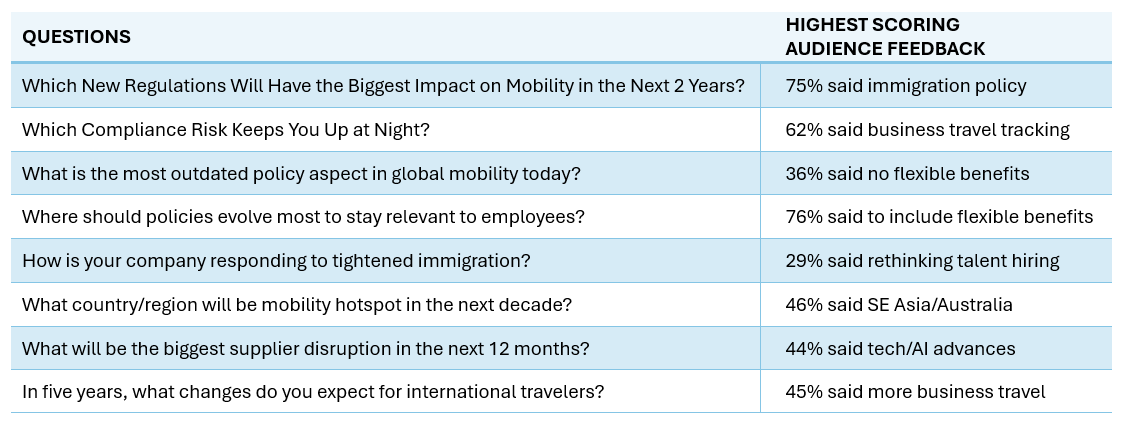
Reflecting the depth of the BAMM membership, subject matter experts in immigration, tax, policy design, global accommodations, and supplier engagement shared their commentary on the current and upcoming state of relocation as perceived by the audience.
Immigration Disruption: The topic of immigration regulation and disruptive impacts on managing global mobility was covered in the opening session. The conversation then moved to other risks and opportunities in mobility.
Compliance/ Business Travel Tracking: Lis Morris from KPMG provided the guidance that tracking is the outcome, not the first step. The business needs to understand that every travel decision involves potential financial, immigration, and duty of care risks. Lis shared a 3-point framework of Assessment (What information is available? What information is needed?), Architecting (Building policy, process and compliance des, and then Action (Deploying training, change management, and tracking solutions).
Outdated Policies/Policy Evolution: Over a third of audience participants identified lack of flexibility as the biggest gap in corporate mobility policies today and an overwhelming three-fourths of respondents said that in order for policies to be more relevant to employees, they have to be more flexible.
Josh Hyatt from Odyssey Relocation and Sheri Sinaga from Aires noted on these topics that programs that are not personalized are likely missing the ability to connect with key talent who feel ignored or under-supported. The lump sum benefit, for example, was called out as “poorly structured financial support” both because it is typically inadequate to the employee’s need (no matter what their employment tier) and outdated because it fails to recognize the need for ‘whole person support’ for key talent. Employees on the move are excited but also stressed. Policy design that takes the person into account means core-flex programs that ensure coverage of key, statutory requirements (like tax and immigration compliance) as well as situation/employee specific needs for destination services, moving services, cultural training and more. As Sheri Sinaga said, “the future is flexibility.”
Responses to Restricted Immigration: Regardless of political perspective, the challenge to employers is a current, pressing shortage of critical talent for certain high impact roles across multiple industry sectors. If talent cannot be brought to the US, options include temporary postings to other countries, or, as a less desirable option, continuing to manage with remote teams, even though that may not be the most efficient way to accelerate innovation and growth.
Global Mobility Hotspots: Southeast Asia and Australia were the most frequently cited locations, followed by the Middle East and Africa. Between building alternative supply chains in Cambodia, Thailand, Malaysia, and Indonesia and Australia’s focus on skilled talent immigration, the countries in the region are seeing expanded interest and relocation activity. Mary Corrales from Synergy noted that cost-sensitivity is a high priority for companies paying for relocation benefits in the region, hence the need for a supply chain that includes a range of housing options, while complying with corporate safety and security standards. Given the early-career cohort moving to the region, there is also growing interest in options like co-living with smaller personal quarters and larger communal living/activity spaces. Growth in the Middle East was noted, along with awareness of planning appropriately for global political risks and disruption.
Disruptions to Suppliers: Jordan Blue, at AIRINC, noted multiple disruptions that mobility service suppliers will need to manage, including ongoing geopolitical and climate events, tariffs and the cost of goods, evolving corporate policies and expectations for supplier agility, and more than anything else readiness to adopt and adapt to AI and the pace of technology-driven change. The industry will benefit from even better predictive analytics, real time benchmarking, and streamlined service processes through AI. At the same time, AI is ‘trained’ to tell people what they want to hear – and that doesn’t tell the whole story of relocation. Engaging with a subject matter expert – in immigration, in tax, and in real estate, moving and destination services- will ensure a level of personalized and operationally efficient service in the AI era.
International Travel: Keeping track of global travelers is a significant accountability across the relocation value chain. And the need will only increase as nearly 50% of BAMM audience members anticipate an increase in business travel in the next five years. As group projects, regional consulting, knowledge transfer, and business start-ups accelerate, the activities associated with travel will need to happen in a compliant and reliable framework. As Brett Sipes from Global Tax Network (GTN) noted, the experience and expertise of the traveler is important, but the ultimate goal is for the business to thrive. The organization needs to enable that success by controlling for risk and educating employees and managers alike.
Dwellworks Response to Challenges and Opportunities in Global Mobility
The challenges and opportunities discussed at the BAMM 2025 Fall Session point to several core competencies of Dwellworks, including:
Global Coverage and Availability of Temporary Living Solutions: Whether the business need is for interim housing for an employee on an extended global assignment or for project teams setting up operations in new or remote locations, we deliver compliant, vetted, and professionally managed housing solutions at the client’s price point in thousands of cities worldwide, including emerging markets across Asia and the Middle East.
Personalized Destination Services: Relocation support should be more than a cash benefit. When an employee accepts a move, the company invests in the value creation that employee will bring to the business in building out a market, accelerating a new product release, or creating a competitive edge in technology. Expert coordination of destination services through both digital and local expert assets means that your talent can access the information they need, whether through online FAQs and agentic assistants or making sense of housing market data in a 1:1 conversation with a Consultant. Our Destination Services network of 2500 local experts provides essential help in 16 countries and thousands of cities.
Strategically Deployed AI: Dwellworks has supported more than half-a-million moves. We’ve translated our ability to understand, analyze and act on core expectations as well as key custom requests into more efficient operations and AI-generated tools and reports, while supporting sentiment analysis and delivering course correction guidance to ensure our teams respond to the specific needs of every employee we assist. From streamlined lease review to itineraries and appointments to hyper local area insights, we’re using AI to support the customer experience.
Flexible Solutions and Price Points: We want to ensure that every client’s investment in their talent is supported with the right solution. We also understand that today’s relocating employees want access to useful information, on demand, in their preferred formats. In response to market expectations, we deliver an array of support solutions, from a fully self-paced and AI-agent supported experience to brief consultations on critical questions to comprehensive management of homefinding and settling in services. Operational excellence and AI-supported efficiency make it possible to deliver cost effective solutions as well as access to award-winning experts who are the best resource to respond to customer-specific needs.
Compliance and Security: Companies need more than assurance that their employees will be well taken care of. They expect complete confidence in data privacy and security, regulatory compliance, and duty of care provided through expert consultation and on-the-ground support. Risk is an unfortunate reality in business and in relocation. Dwellworks delivers both comprehensive business-to-business assurance as well as situation unique customer care.
For more information about Dwellworks and Dwellworks Living unique, award-winning approach to talent mobility management, read our blogs and contact us at living@dwellworksliving.com.
About Dwellworks:
Dwellworks is the world’s largest provider of destination-related services and temporary living solutions for the globally mobile workforce and business travelers. We provide business-to-business solutions for Fortune 1000 and emerging companies directly and through their relocation management partners. Whether a company needs to relocate its employees across the country or around the world, we provide a range of support services to help employees and their families transition successfully from their home location to a new destination.
Dwellworks supports the diversity of our clients’ globally mobile workforce with personalized destination solutions in 16 countries, covering hundreds of major relocation markets. Dwellworks Living, our global furnished temporary living solution, offers corporate housing accommodations for relocation and business travel customers in 125 countries. Our full-service real estate brokerage, Station Cities, supports home rentals, sales, and purchases in the Tri-State New York area and Chicago. Visit our homepage, learn about our services, and read our blogs to learn how we can help with your relocation and business travel needs.
ABOUT BAMM
Bay Area Mobility Management (BAMM), https://mybamm.org, is the premier forum for mobility professionals in the San Francisco Bay Area, providing leadership, education, and resources as well as programs, events, and networking opportunities for the global mobility and relocation communities.