

What Are the Key Trends in APAC Talent Mobility for 2026?
Dima Lorenz, Managing Director, Asia Pacific
Wishing a happy and prosperous Year of the Fire Horse in 2026, we are happy to share our views on the fast-evolving landscape of global mobility in Asia Pacific.
As we navigated through 2025, global mobility in Asia continued its structural transformation from the traditional patterns of the past. What was once a region defined by Western-inbound talent flow is now a complex web of intra-regional migration, high-tech R&D hubs, and strategic "de-risking" relocations that help reset business priorities, infuse talent into aging national workforces, and implement business processes to accelerate efficiency and adoption of Tech & AI.
What Have Been the Most Significant Changes in the APAC Region?
Over the last years we have seen the talent mobility industry in Asia Pacific moving beyond the post-pandemic recovery phase into a new era of purpose-driven mobility; one that is strongly influenced by the growing sphere of influence from China and India. Organizations are no longer just moving people to Asia to oversee investments, outsourced services, and manufacturing. Talent is moving within and from APAC on regional assignments to expand regionally generated revenue streams and strategies.
The Pillars of Change in Mobility Strategy: Commercial, Economic, and Geopolitical
1. Commercial: The Tech-Led R&D Migration
- The commercial focus has shifted from "Regional Headquarters" (sales, marketing & production for companies whose headquarters are elsewhere) to "Global Capability Centers" (GCCs). As companies in Asia race toward AI, robotics and biotech breakthroughs, talent is following the labs. This has turned cities like Bengaluru, Hyderabad, Shenzhen, Guangzhou, Hangzhou, and Tokyo into high-demand relocation destinations for specialized engineers and other technology-related talent, moving them away from traditional tech hubs like San Francisco, Seattle, or London.
2. Economic: Fast Growth and a Sensitivity to Costs
- While regional GDP growth remains resilient (forecasted at 4.6% to 5.1% for developing Asia and over 6% for India in 2025/2026, according to the Asian Development Bank), the economic reality for many traditional expatriates is one of "cost-containment." Classical ‘West to East’ assignments are fewer and expensive and with inflation on the rise in many markets companies are looking towards less costly solutions.
3. Geopolitical: "China Plus One" and Beyond
- Geopolitical tensions continue to drive the "China Plus One" supply chain strategy. However, the last few years have seen a fascinating evolution: it is no longer only Western firms diversifying from an exclusively China-focused supply chain. Chinese firms themselves (and with increasing frequency, Indian businesses as well) are now key drivers of regional mobility based on expanded operations outside their national markets. Whether exporting production capacity to other Southeast Asia hubs to mitigate tariff risks or to address regional demand, these Asian-headquartered multinationals are fueling a surge in outbound assignments from their mainland offices to Vietnam, Thailand, and Malaysia and further afield in EMEA and Australia.
How Are Visa and Immigration Regulations Impacting APAC Talent Mobility?
Across several countries in APAC as is also the case in Europe and North America, both an aging population and a skilled-talent deficit present real challenges to growth. While many countries have modernized their visa and immigration systems (leading as well to greater controls and compliance requirements) and have added specialized visas for essential skills needs, several countries, such as Japan and Singapore, also have strong protections for their internal labor force. The tension between the need for talent, the increasing costs associated with immigration and relocation, and the requirements for compliance and risk management are additional factors impacting global talent mobility strategies in the region.
Growth Hotspots: Regional Deep Dives
China & Hong Kong: The Selective Comeback
- Mainland China continues to see a multi-year downturn in traditional incoming, international relocation. The high inventory of office and residential housing supply in cities like Shanghai and Beijing offers more pricing leverage for incoming transferees, but corporate demand for sending expensive talent in the first place remains restrained. At the same time, domestic companies are competing, and potentially leading, in the technology race, specifically in AI and Robotics, and that is a driver of an increase of outbound mobility in these sectors.
- Hong Kong, by contrast, is staging a "selective comeback." The Top Talent Pass Scheme (TTPS) has been hailed by many as a major success, attracting over 100,000 applications and resulting in an influx of mainland Chinese talent seeking new opportunities in the Special Administrative Region. While much of the volume does indeed come from mainland China (often with limited formal relocation services benefits), this new talent influx also includes valuable talent from Southeast Asia and has been seen as a beneficial program for the Hong Kong financial and wealth management sector.
India’s Rise: From Back-Office to R&D Powerhouse
- India is again the standout market for 2026. Bengaluru, Hyderabad, and Pune are no longer just hubs for outsourced cost-saving operations, they are evolving into global R&D centers for AI and biotech. Bengaluru itself, often referred to as the "Silicon Valley of Asia," is seeing a massive influx of senior leadership and workforce. Similar to China, India has also become a strong source of outbound talent mobility for assignments within Asia, as well as to traditional EMEA and Americas destinations.
Japan’s Revival: The Stability Magnet
- Tokyo is experiencing a rare, sustained "boom" in its living sector. With a weak yen making the cost of entry attractive for foreign firms (though with inflationary impacts for local residents), and a reputation for political and economic stability in a volatile region, Tokyo has become a top target for cross-border talent. Japan now has its highest percentage of foreign-born talent in decades, as the country, like many in Europe, addresses the need for top-skilled talent in an aging population.
Australia’s dilemma: The Housing Bottleneck
- Sydney and Melbourne remain key locations for the APAC operations of various industries. Despite several interest rate hikes in 2025, impacting businesses and individuals alike, investment in built-to-rent housing continues to boom. The supply, however, remains inadequate to the current demand and the rental market is punishingly tight. As in many global boom towns, corporate assignees compete with locals and students for a limited pool of premium rentals.
Residential Real Estate: The Rental Reality Check
With a still unstable global political and economic outlook driving uncertainty in talent mobility planning, the biggest challenge for mobility managers in 2026 will be "housing anxiety” for those associates and leaders approved for moves.
Corporate professionals tend to be interested in premium neighborhoods, where rates are highest. Here is the state of the some of the key rental markets, including vacancy rates and trends.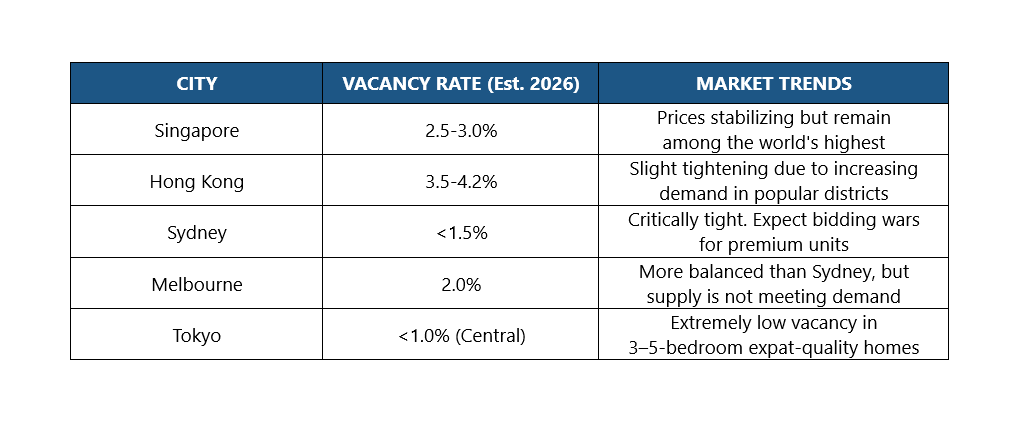
2026 Forecast: Surprising Trends & Emerging Hotspots
As we look toward 2026, three shifts are likely to define the year:
1. Accelerated ‘East to West’ Mobility
With the expansion of Chinese, Indian, and Southeast Asian conglomerates in the tech, robotics, and AI space, we are expecting a further increase in outbound moves from the APAC region into EMEA, Americas and Australia. The Middle East, led by Riyadh, Dubai and Qatar remain interesting destinations for these emerging businesses, as are London, Dublin, and Frankfurt in Europe, Seattle and Silicon Valley in US, and Perth and Brisbane in Australia.
2. The "Secondary City" Boom
As some capital cities become increasingly unaffordable and with real estate vacancies at a challengingly low rates, we are seeing a boom in secondary hubs for inbound professional populations. Ho Chi Minh City (Vietnam) and Penang (Malaysia) are emerging as significant regional relocation hotspots, particularly for semiconductor and electronics manufacturing talent. Ahmedabad (India) is quietly becoming a hub for renewable energy and financial services in the surrounding Gujarat International Finance Tec-City (GIFT City) area, attracting regional transfers.
3. A Rise in Sustainable Relocation
While official governmental policy in the US may support legacy fossil fuel industries, traditional West-to-East moves and corporate mobility policies (and business operations) in APAC are expected to strengthen their "green " efforts in 2026. This focus is not only for beneficial environmental impact but because it aligns with more efficient ways of working overall and the adoption of low-carbon, low-cost, highly efficient energy solutions throughout the region.
Consistent with this trend, we expect a shift toward "Slow Mobility"—with fewer short-term "fly-in-fly-out" assignments in favor of longer, more sustainable, potentially multi-purpose assignments. Project work is a growing sector in global mobility, for individuals and project teams on assignment for weeks and months, but not necessarily years. "Local-plus" contracts fall within this trend as deemed less expensive than traditional assignments and lower on the carbon footprint of global talent programs.
Dwellworks Expertise in APAC
Through legacy operations, acquisitions, and organic growth, Dwellworks and Dwellworks Living have become a significant global mobility presence in Asia Pacific, providing destination services for extended assignments to Hong Kong, Singapore, Australia, and Guam, and Temporary Living solutions across the entire APAC region. We offer our corporate housing & temporary living clients the administrative and tax benefit of global as well as local invoicing (e.g. in China & India), as well as the expertise of our extensive real estate networks in key cities including Sydney, Singapore, Shanghai, and of course Hong Kong.
Our Consultants and serviced accommodations partners, with their longstanding expertise in rental markets and deep familiarity with landlords and property managers, are experts at sourcing housing for client-unique expectations. Whether for cost-efficient solutions for group project/training needs in Bengaluru, entry level financial services professionals on rotational assignments in the Greater Bay Area/Special Administrative Region, executive housing in Tokyo, or hard-to-find options in competitive Sydney, we are a preferred provider to corporate clients and relocation management companies.
Dwellworks and Dwellworks Living are also leaders in sustainability advocacy in mobility, consistent with a commitment to efficient operations, innovation, and positive impact in the communities we serve.
Read our market reports here and our most recent ESG Impact Report here and learn more about our services at Dwellworks.com.
Conclusion
The narrative of corporate mobility in 2026 is one of strategic realignment. While the challenges of housing supply and geopolitical friction remain, the opportunities in India and China’s Tech sectors and Southeast Asia’s manufacturing surge offer a vibrant future for business growth and hence the mobility industry, in particular for Asian-based businesses expanding their efforts overseas.
ABOUT DWELLWORKS:
Dwellworks is the world’s largest provider of destination-related services and temporary living solutions for the globally mobile workforce and business travelers. We provide business-to-business solutions for Fortune 1000 and emerging companies directly and through their relocation management partners. Whether a company needs to relocate its employees across the country or around the world, we provide a range of support services to help employees and their families transition successfully from their home location to a new destination.
Dwellworks supports the diversity of our clients’ globally mobile workforce with personalized destination solutions in 16 countries, covering hundreds of major relocation markets. Dwellworks Living, our global furnished temporary living solution, offers corporate housing accommodations for relocation and business travel customers in 125 countries. Our full-service real estate brokerage, Station Cities, supports home rentals, sales, and purchases in the Tri-State New York area and Chicago. Visit our homepage, learn about our services, and read our blogs to learn how we can help with your relocation and business travel needs.